


“Cotidiano Encantado emerges from memory, from the earth, and from the enchanted way I learned to look at the world.”


I was a deeply curious child, enchanted by the simplest things and completely surrendered to whatever touched the deepest part of my soul. There was always a kind of silent calling within me. Certain things simply pulled me in, and art was the strongest of them all.
I was born into a cradle of clay and raised within a universe where the dolls already existed. The culture was already being built every day through the hands of master artist Izabel Mendes da Cunha, the women in my family, and so many other women from the Jequitinhonha Valley. By the time I arrived, this universe was already in motion. Our story was already being told and transformed through clay; the magic was already happening.
Looking at that world of clay always felt like an immense enchantment. There was no rational explanation for it. It was a silent force that called me, pulled me, and carried me into that universe. It felt as though I had been born for it. Almost as if I were reconnecting with something I had deeply missed.
Today, I carry that same essence into my art. I am both a descendant and a branch of this great tree, and perhaps it is precisely because I arrived and encountered this living world before me that my way of seeing was shaped in this way: a gaze that tries to recognize the beauty that exists within things.
Because when we cleanse the lens through which we see the world, art reveals something very simple and powerful: the ability to enchant.
Cotidiano Encantado (“Enchanted Everyday Life”) is born exactly from this place. It is born from the memory of that child and from the way I perceived the world back then. What I create today is, in many ways, a translation of my childhood vision into the works I make.
The dolls remain the classic dolls of the Jequitinhonha Valley, but now they carry something more: the enchantment of a lifetime devoted to seeing, feeling, and sharing the simple beauty of our everyday life.
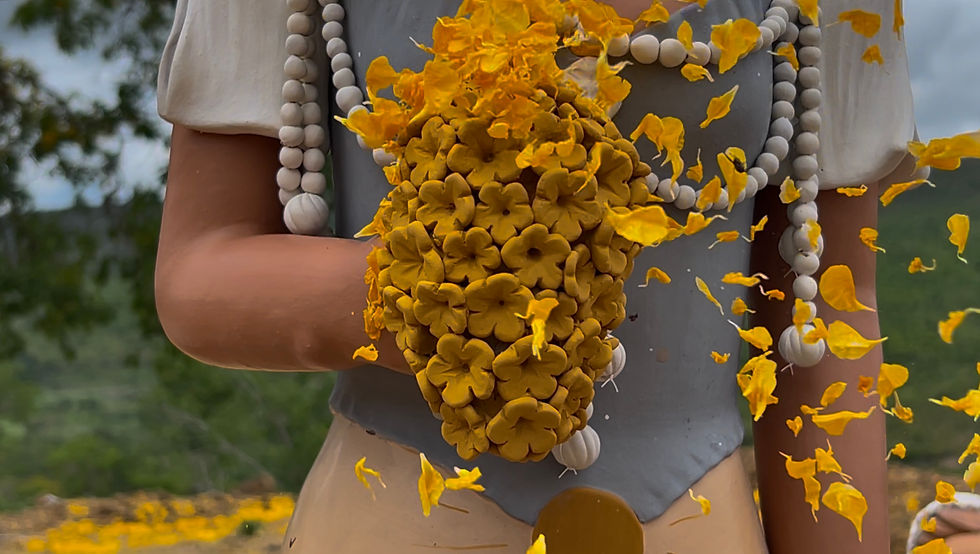
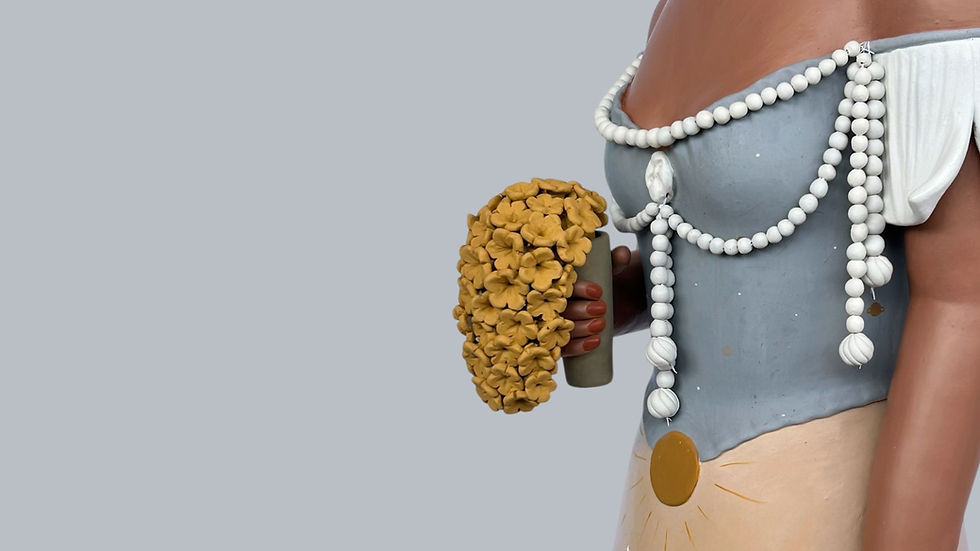
The pearls present throughout the works symbolize the people who built and continue sustaining this ceramic tradition. Each pearl represents a life, a memory, and a presence within the history of ceramics in the Vale do Jequitinhonha. Creation, therefore, is not understood as an individual act, but as a collective continuity carried across generations.

“The dresses become landscapes where the Vale do Jequitinhonha is carefully preserved through memory and imagination.”

Before the figurative sculptures, there was utility. In the Vale do Jequitinhonha, vessels, jars, and containers were part of daily life long before figurative ceramics became internationally recognized. As an extension of Cotidiano Encantado, Augustto Ribeiro develops a collection of utilitarian objects that move between sculpture, memory, and function. These forms echo the silhouettes of traditional dolls and ancestral domestic objects, creating pieces that inhabit both contemporary art and collectible Brazilian design.


